
Call and member nodes
Tell calls apart by where their methods are declared, then read GET pills, SET nodes, and assignments back into C#.
On this page
A method can call its own class, another class, and code the project cannot resolve, all within a few lines. Color tells you whether a call stays on this class, reaches another class (yours, Unity’s, or .NET’s), or names a method nothing in the project declares. Member nodes then show where the values came from and where they go.
The C# under each entry comes from the Platformer sample unless it says otherwise. For example, PlayerController.CollectCoin in the sample calls four neighbors in a few lines.
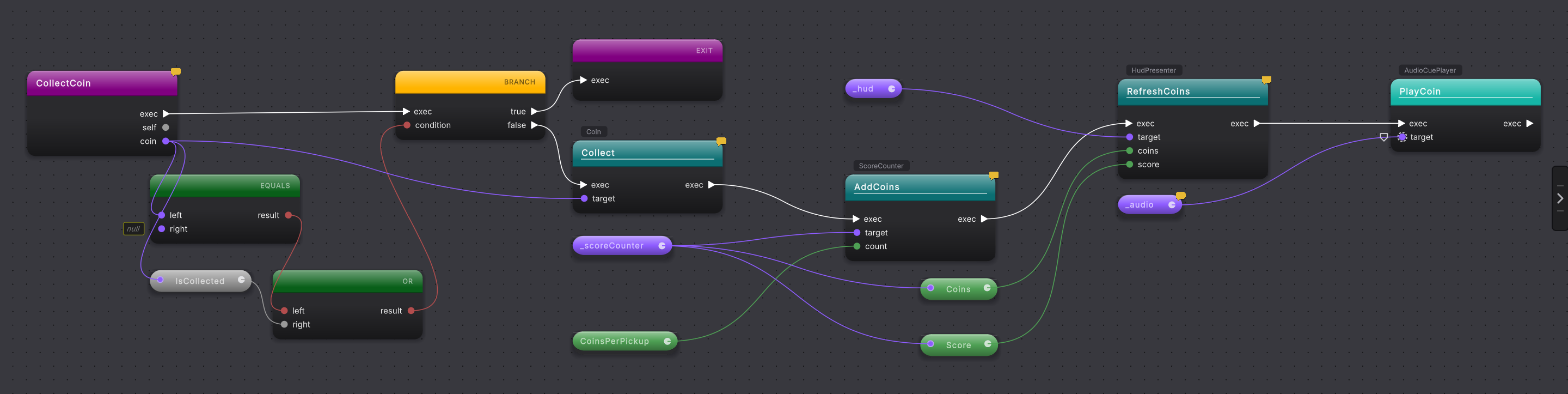
CollectCoin in the Platformer sample reads a guard, then calls the coin and the score counter, then the HUD and the optional audio service.Call this class
Section titled “Call this class”Purpose. Calls a method declared on the class you have open or one of its base classes. Unqualified calls, this calls, and base calls share the light teal family.
| Pin | Direction | Type |
|---|---|---|
| exec | Input | exec, impure call only |
| target | Input | Owning class, when shown |
| each argument | Input | Declared parameter type |
| result | Output | Declared return type, when non-void |
each out argument |
Output | Declared parameter type, labeled with the variable it fills |
| exec | Output | exec, impure call only |
Guide: Method calls.
Call another class
Section titled “Call another class”Purpose. Calls a method declared on another type: a class elsewhere in your project, or a Unity or .NET type the compiler resolves. It uses dark teal, with the declaring type named above the header.
| Pin | Direction | Type |
|---|---|---|
| exec | Input | exec, impure call only |
| target | Input | Declaring class type, unless static |
| each argument | Input | Declared parameter type |
| result | Output | Declared return type, when non-void |
each out argument |
Output | Declared parameter type, labeled with the variable it fills |
| exec | Output | exec, impure call only |
Guide: Call a neighbor.
Logging and asserts are ordinary calls
Section titled “Logging and asserts are ordinary calls”Place Log from the LOGGING group of the canvas menu, or drag from a white exec pin onto empty canvas and pick it there. The node is the same before and after Compile.
Call external
Section titled “Call external”Purpose. Calls a method the project cannot resolve: no indexed source declares it, and the compiler cannot find it in any referenced library. That can happen when a script copied from a tutorial calls a package this project does not have. The node is slate gray with ↗ after the title. Resolved Unity and .NET calls are not external; they are dark teal like any other class.
| Pin | Direction | Type |
|---|---|---|
| exec | Input | exec, impure call only |
| each argument | Input | No declared parameter, so pins are named Arg0, Arg1, and so on, typed by the value written |
| exec | Output | exec, impure call only |
The example below is a short illustration written for this page: CoinAnalytics exists nowhere in the Platformer sample, so the compiler cannot resolve the call.
Guide: Method calls.
GET pill
Section titled “GET pill”Purpose. Reads a field, property, local, this, or static value. The compact pill has no exec pins. It can fan one read into several consumers; Split pill on one of those wires gives that consumer its own pill, and Split pins on the pill separates every read at once.
| Pin | Direction | Type |
|---|---|---|
| target | Input | Owning instance type, for an instance member |
| value | Output | Declared member or local type |
Guide: Get and set.
Purpose. Writes a field, property, or local as a statement. SET is an impure navy node because it changes state and participates in exec flow. The variable’s name is the left label of its header and SET is the keyword in its right caption. A member write such as keyboard.numpadEnterKey.wasPressedThisFrame = true keeps its dark owner-path chip above the card, with the leaf member as the name. The value input and the passthrough output are both labeled Value. Only the SET for the statement that declares a local with a computed value has a quiet second line under the name, reading local and the type, such as local Vector2; later writes to that local and field or property writes have no second line.
| Pin | Direction | Type |
|---|---|---|
| exec | Input | exec |
| target | Input | Owning instance type, for an instance member |
| Value | Input | Declared member type |
| Value | Output | Declared member type, the value just written |
| exec | Output | exec |
Guide: Get and set.
Assignment
Section titled “Assignment”Purpose. Writes a target using ordinary or compound assignment. The assignment family covers local declarations and mutation shapes when the renderer distinguishes them from a plain SET.
| Pin | Direction | Type |
|---|---|---|
| exec | Input | exec |
| target | Input | Assignable value type |
| value | Input | Compatible value type |
| value | Output | Assigned value type |
| exec | Output | exec |
Guide: Operators and expressions.